What is Bharatanatyam?
Bharatanatyam is one of the oldest and most revered classical dance forms of India, with origins that trace back over 2,000 years. Once known as Dasiattam or Sadir, it was formally christened Bharatanatyam by the Music Academy of Madras in the early 1930s. While it was nurtured in the temples of Tamil Nadu, today Bharatanatyam has become a global art form, celebrated not only across India but also in cultural centres worldwide, particularly within the Indian diaspora.
Roots in Tradition
The grammar and aesthetics of Bharatanatyam are rooted in ancient Sanskrit texts such as the Natya Shastra by Sage Bharata and the Abhinaya Darpana by Nandikeshwara. Its modern structure, however, is largely credited to the Tanjavur Quartet of the 19th century, who codified the margam — the traditional repertoire of Bharatanatyam still followed today. This legacy was preserved by generations of dedicated Gurus and the Isai Velalar community of Tamil Nadu, who carried forward the art with devotion and discipline.
The Sacred and the Secular
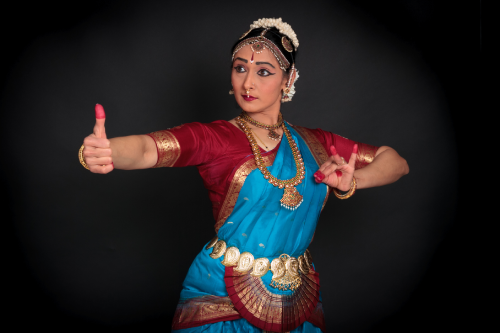
Bharatanatyam was originally performed in temples as an offering to the divine — a form of Upachārā (ritual service) that combined movement, music, and storytelling to bring devotees closer to God. Dancers depicted stories from Hindu epics such as the Rāmāyana, Mahābhārata, and Purānas, embodying deities through intricate gestures (mudras), expressions (abhinaya), and rhythm (nritta). Over time, the dance also moved beyond temple walls, gracing royal courts and community gatherings. Overall, Bharatanatyam has retained its sanctity and spiritual essence through centuries.
Key Elements of Bharatanatyam
To truly appreciate this art form, it helps to know its distinctive features:
- Nritta (Pure Dance): Intricate rhythmic footwork and graceful movements showcasing geometry, symmetry, and stamina.
- Nritya (Expressive Dance): Storytelling through facial expressions and hand gestures, conveying emotions and narratives.
- Natya (Dramatic Dance): A combination of movement, music, and drama, bringing mythology and philosophy to life.
- Costume & Music: The traditional costume, temple jewellery, and expressive makeup enhance the visual appeal, while Bharatanatyam is performed to the accompaniment of Carnatic music, deepening its spiritual and emotional impact.
Bharatanatyam Today
Today, Bharatanatyam is recognised as an Intangible Cultural Heritage of Humanity by UNESCO. It continues to evolve, with artists across the globe exploring new themes while staying rooted in tradition. Whether performed on a temple platform, a theatre stage, or an international festival, Bharatanatyam remains a celebration of discipline, devotion, and storytelling.